
Updated 18 September 2025 at 23:25 IST
Beyond Anecdotes: Operation Sadbhavana Through Data and Doctrine
An evidence-based critique of claims against Operation Sadbhavana in Jammu & Kashmir, highlighting 25 years of education, healthcare, infrastructure, women’s empowerment and youth engagement as part of India’s counterinsurgency strategy.
- Opinion News
- 5 min read

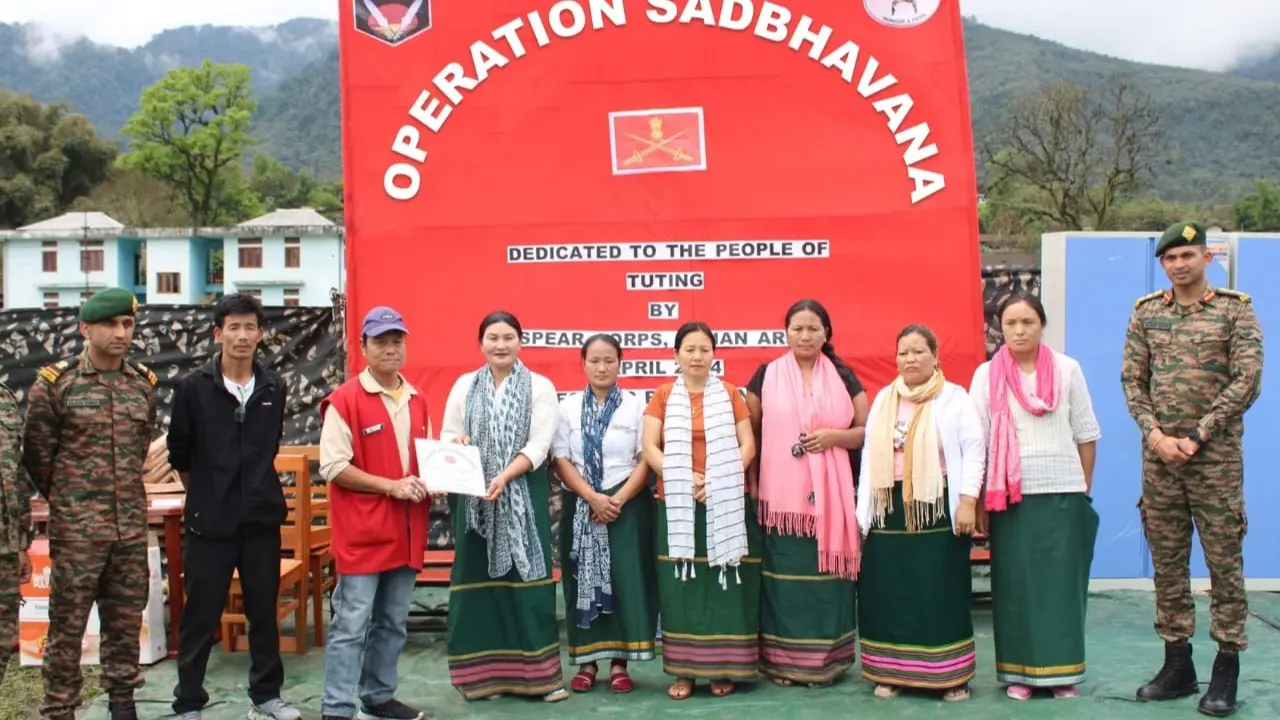
In counterinsurgency, perception can matter as much as operations. Narratives often travel faster than facts, and selective accounts can distort the picture in contested environments. The latest illustration of this is Susan McLoughlin’s paper, “Goodwill as Bad Faith: Unmasking Operation Sadbhavana in Jammu & Kashmir”, published by the Kashmir Law & Justice Project.
The author attempts to recast the Indian Army’s Operation Sadbhavana as a façade, built on coercion rather than care. Her argument, however, rests primarily on anecdotal testimony from a single village and sweeping generalisations. What is missing is empirical analysis. A 25-year initiative that has touched thousands of lives across Jammu & Kashmir cannot be evaluated on isolated grievances. It must be judged through data, doctrine, and demonstrable outcomes.
Counterinsurgency and the Centrality of People
From the late 1990s onwards, the Indian Army adopted a principle shared by militaries worldwide: in counterinsurgency, the people are the centre of gravity. Excessive force breeds alienation; calibrated action, coupled with welfare, builds legitimacy.
Sadbhavana was born of this doctrine. It was not charity, nor a substitute for governance, but a strategic necessity in a region where conflict had hollowed out state institutions. The Army, deployed in remote and hostile areas, became the first responder — in education, healthcare, infrastructure, and even disaster relief.
Advertisement
Critics who dismiss this as “militarised welfare” overlook the doctrinal point: Sadbhavana is not a detour from counterinsurgency strategy but an integral element of it.
Education: From Statistics to Success Stories
One of the strongest claims in McLoughlin’s piece is that Sadbhavana has failed to deliver meaningful educational outcomes. The data suggests otherwise.
Advertisement
43 Army Goodwill Schools today educate 16,379 students and employ nearly 1,000 staff. Over 6,000 students graduated in the last two years alone.
1,150 weaker-section students received scholarships; 229 marginalised youth were sponsored for higher studies; and more than 200 have cleared national-level exams like JEE, NEET, and UPSC.
The literacy rate in Jammu & Kashmir has steadily improved, from 68.7% in 2018 to 73.2% in 2024 — with female literacy making the sharpest gains. Flagship initiatives like the Army’s “Super-40” programme, modelled on India’s celebrated Super-30, have enabled Kashmiri students to enter the IITs and NITs, reshaping family trajectories that once seemed trapped by conflict.
To cite isolated school closures while ignoring these trends is not analysis — it is omission.
Healthcare: Filling the Institutional Vacuum
Healthcare in mountainous terrain is a structural challenge. Sadbhavana stepped into this vacuum, often as the only provider in remote valleys. Between 2022 and 2024, the Army organised 302 medical camps for 25,000 civilians and 119 veterinary camps for 7,000 animals. Health centres were equipped with ultrasound machines, ECGs, and oxygen facilities.
The results are visible in hard data. Infant mortality in J&K fell from 38 per 1,000 live births in 2018 to 29 in 2024, while households with access to clean water rose from 65% to 78%. These improvements are corroborated by World Bank indicators, not internal Army reports.
To ignore these outcomes is to mistake localised grievances for systemic realities.
Infrastructure: Roads and Connectivity as Strategy
In conflict zones, infrastructure is not just development; it is a strategic tool. Roads connect villages to markets and hospitals, reduce isolation, and prevent extremist recruitment.
Since 1998, Sadbhavana has executed over 10,000 projects worth ₹450 crore. These include footbridges, electrification, water schemes, and community centres. The case of Pir Topa, cited critically in McLoughlin’s article, in fact demonstrates the opposite. The village has gained roads, upgraded schools, solar lighting, and a revitalised health centre. For Gujjar and Bakkarwal families, this is not tokenism — it is integration.
Women’s Empowerment and Youth Engagement
No counterinsurgency strategy can endure without empowering women and youth. Sadbhavana has made both central to its design.
Women’s empowerment: Over 80 community centres now train women in tailoring, IT, and entrepreneurship. In two years, 241 projects worth ₹6.82 crore have enabled women to open bakeries, tailoring units, and craft enterprises — often their first independent income.
Youth engagement: 399 projects worth ₹10.57 crore have trained youth in mechanics, horticulture, and tourism. Over 100 Khelo India centres and Leh’s Centre of Excellence now nurture athletic talent.
These are not abstract programmes; they are real-world alternatives to radicalisation.
Building Information Resilience
In an era where disinformation fuels unrest, Sadbhavana has embraced communication. The launch of Radio Baramulla (89.6 FM) and Radio Uri (90.0 FM) in 2024 provided platforms for accurate news, cultural expression, and youth voices. By countering propaganda with local ownership, these stations strengthen the social fabric.
The Security Dividend
Perhaps the most under-analysed outcome of Sadbhavana is its link to declining militancy. Areas with dense project implementation have seen fewer youth picking up arms, more joining the police and Army, and improved community cooperation. While correlation is not causation, the pattern is too consistent to ignore.
A Flawed Critique
McLoughlin’s article suffers from three methodological flaws:
1. Over-generalisation from anecdote — using one village’s grievances to indict a statewide programme.
2. Absence of empirical data — ignoring literacy gains, infant mortality reduction, and infrastructure growth.
3. Neglect of doctrine — failing to recognise Sadbhavana as an established counterinsurgency practice, not an ad hoc invention.
Criticism is welcome when it sharpens policy. But critique without evidence risks collapsing into polemic.
The Way Ahead
Operation Sadbhavana has not been perfect. Like all long-term initiatives, it requires regular evaluation and improvements. Programmes must adapt to changing community needs, deepen linkages with civil administration, and transition gradually into state-led development.
Yet to dismiss Sadbhavana as “bad faith” ignores two decades of progress: schools rebuilt, villages connected, women empowered, and lives saved. For thousands of families, it has been the bridge between survival and opportunity.
Operation Sadbhavana demonstrates that in counterinsurgency, the rifle and the roadmap must go hand in hand. Security without trust is brittle; trust without development is unsustainable. For Jammu & Kashmir, Sadbhavana has offered both — not as a gesture of charity, but as a strategic investment in stability.
For India’s armed forces, this initiative affirms a larger lesson: nation-building in conflict zones demands more than force. It demands patience, presence, and people at the centre of gravity.
Published By : Shruti Sneha
Published On: 18 September 2025 at 23:25 IST