
Updated 8 November 2025 at 17:37 IST
ISRO Releases Chandrayaan-2 Lunar Orbiter Data To Boost Moon Polar Research
ISRO shares new Chandrayaan-2 orbiter data revealing key properties of the Moon’s polar surface. It is a significant step in India’s space contribution to global lunar exploration.
- Science News
- 2 min read

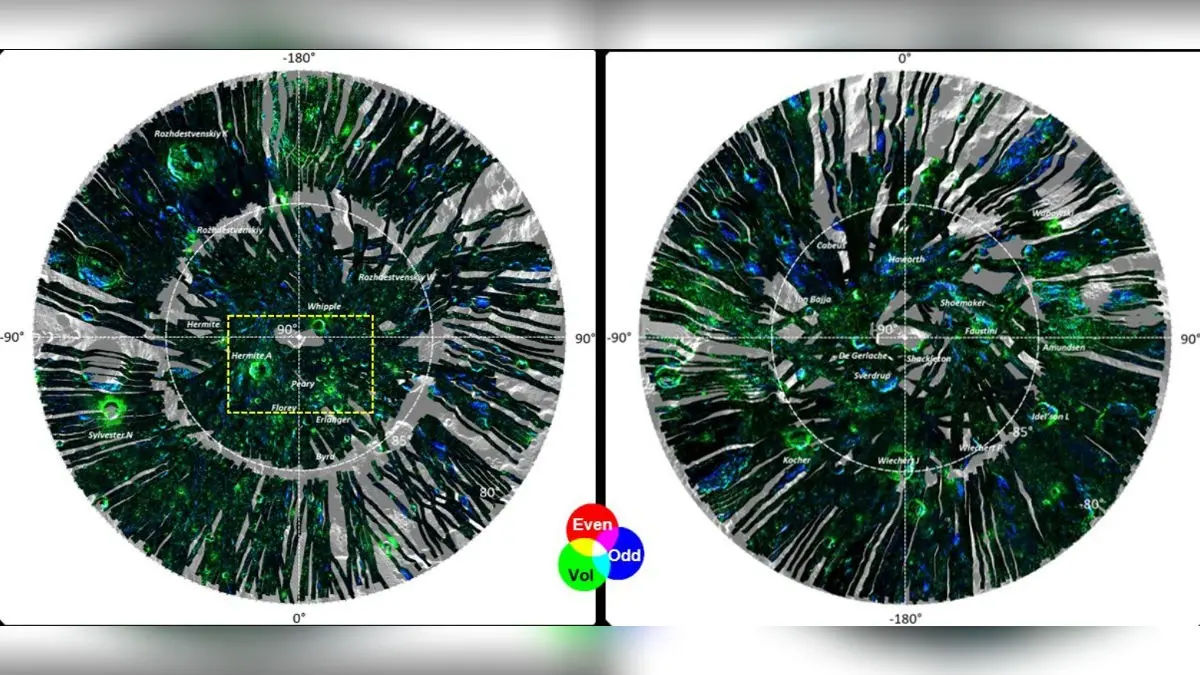
Bengaluru: Indian Space Research Organisation (ISRO) has released Chandrayaan-2 lunar orbiter data to boost moon polar research.
The Chandrayaan-2 Orbiter has provided new data from its Dual Frequency Synthetic Aperture Radar (DFSAR). This data offers a detailed, high-resolution view of the Moon’s polar regions.
Scientists at ISRO’s Space Applications Centre (SAC) in Ahmedabad have processed around 1400 radar datasets. They created polarimetric mosaics for the North and South Poles, spanning a latitude range of 80 to 90 degrees. This work has given us valuable new insights into the Moon's surface and subsurface.
The DFSAR payload is a groundbreaking tool. It is the first to map the Moon using the L-band in full-polarimetric mode at a remarkable resolution of 25 metres per pixel. This radar technique sends and receives signals in both vertical and horizontal directions. It is perfect for precisely describing the physical and electrical properties of the lunar surface.
Advertisement
Unlocking the Polar Regions
The algorithm developed by ISRO has produced important data products for future lunar observation. These maps provide essential information on the possible presence of water ice, surface roughness, and the material's dielectric constant. This constant relates to the density of the lunar surface material.
The data products include key points that help differentiate surface features:
Advertisement
- Circular Polarisation Ratio (CPR): A key indicator of the potential presence of water ice.
- Single bounce Eigenvalue Relative Difference (SERD): Used to represent surface roughness.
- T-Ratio: Directly related to the material's dielectric constant.
- Polarimetric decomposition components: These display different types of radar scattering (odd, even, volume, helix), helping to understand subsurface structure.
Significance
The Moon’s polar regions are essential because they preserved the early chemical conditions of the solar system. This 'fossil record' is important for understanding how planetary bodies, including Earth, have evolved.
The DFSAR polar provides detailed information on physical and electrical characteristics. They work well with hyperspectral data, improving scientists’ ability to study the polar environment and mineral distribution. This data marks a key step toward examining lunar polar regions for future exploration missions, particularly those focused on using lunar water resources.
Published By : Namya Kapur
Published On: 8 November 2025 at 17:34 IST