
Updated 13 December 2025 at 16:35 IST
How Did Jupiter's Icy Moon Europa Get That 'Spider-Like Scar'? Here's What Scientists Have To Say
Europa, one of Jupiter’s icy moons, shows a bizarre spider-like scar on its surface. Scientists now explain the possible cause behind this strange planetary feature.
- Science News
- 2 min read

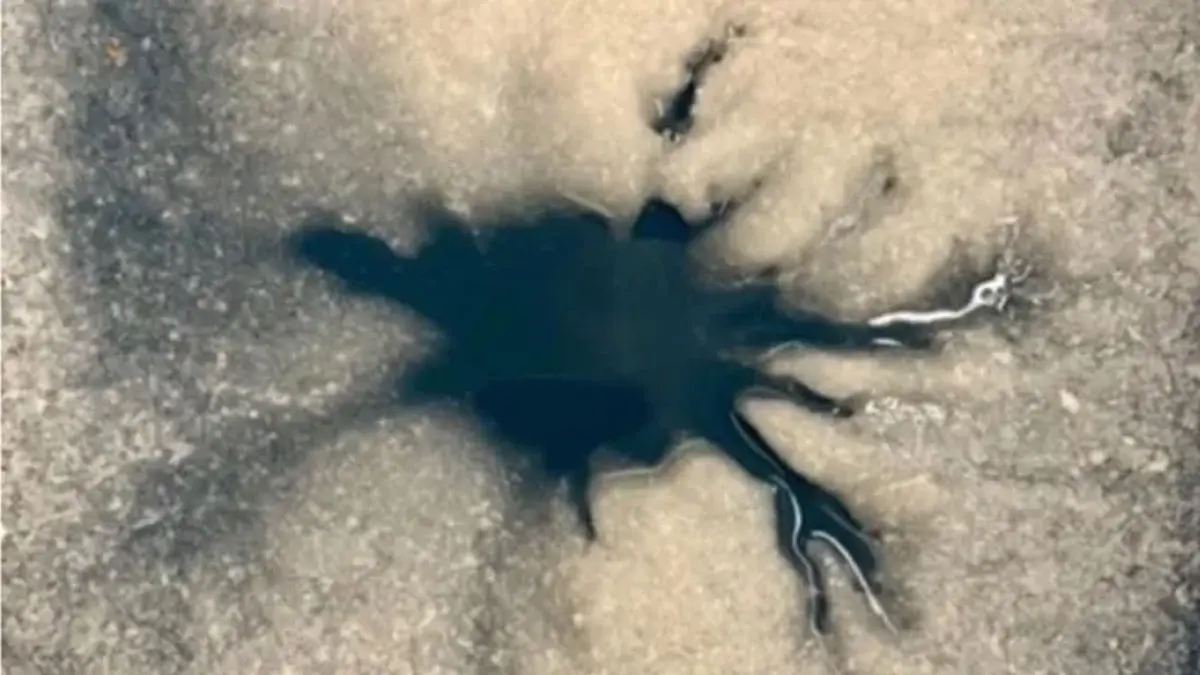
A peculiar, spider-like scar on Jupiter's icy moon Europa indicates a place where salty water once erupted through its broken crust. Within Europa's Manannán crater, a distinctive structure formally dubbed Damhán Alla, an Irish word meaning "spider" or “wall demon", was discovered by NASA's Galileo satellite, whose mission ended in 2003.
Scientists at Trinity College Dublin are finally explaining the formation of the starburst-like pattern, first discovered in the late 1990s. The feature resembles Earth's "lake stars" and appears as a spider-like look from delicate, branching ridges and troughs created by flowing meltwater.
What is Damhán Alla?
The Damhán Alla features have originated from briny water eruptions beneath the moon's ice, providing hints about subsurface liquid water and the possibility of life on Europa, according to field observations, laboratory research, and computer modelling. "The significance of our research is captivating," the study's lead author, Lauren McKeown, said in a statement.
These kinds of surface characteristics can reveal a lot about what's happening underneath the ice. They may indicate nearby brine pools beneath the surface if we see more of them with Europa Clipper. When snow falls on frozen lakes on Earth, holes are created in the ice that allow water to flow upward and melt the surrounding snow, creating radial, branching channels as it spreads.
Advertisement
This is how lake stars appear. Nature frequently observes these patterns, demonstrating the fluid and energy flow through various surfaces, from gushing channels to lightning scars. According to the researchers, Europa's version would form similarly; apart from this scenario, the liquid would be salty brine that was pushed upward after an impact broke the ice shell.
Such brine may flow momentarily in the icy temperatures of Europa, creating branches that resemble stars before freezing in place. The characteristics, such as Damhán All, may indicate isolated areas of liquid water trapped in Europa's crust. Higher-resolution photos from NASA's Europa Clipper mission, which is expected to reach the Jupiter system in April 2030, may provide fresh insights into the icy moon, while current research is restricted to images from the Galileo probe.
Advertisement
"Lake stars are fascinating, and they are pretty common on snow- or slush-covered frozen lakes and ponds," McKeown said in the statement. “It is wonderful to think that they may give us a glimpse into processes occurring on Europa and maybe even other icy ocean worlds in our solar system,” he further said.
Published By : Namya Kapur
Published On: 13 December 2025 at 16:35 IST