
Updated 26 November 2025 at 12:52 IST
NASA's Perseverance Rover Discovers Possible Meteorite on Mars for First Time in 5 Years
Meteorite hunting is a side quest for Perseverance, whose primary job is to search for signs of ancient life in Jezero and collect rock cores for a possible sample return.
- Science News
- 3 min read

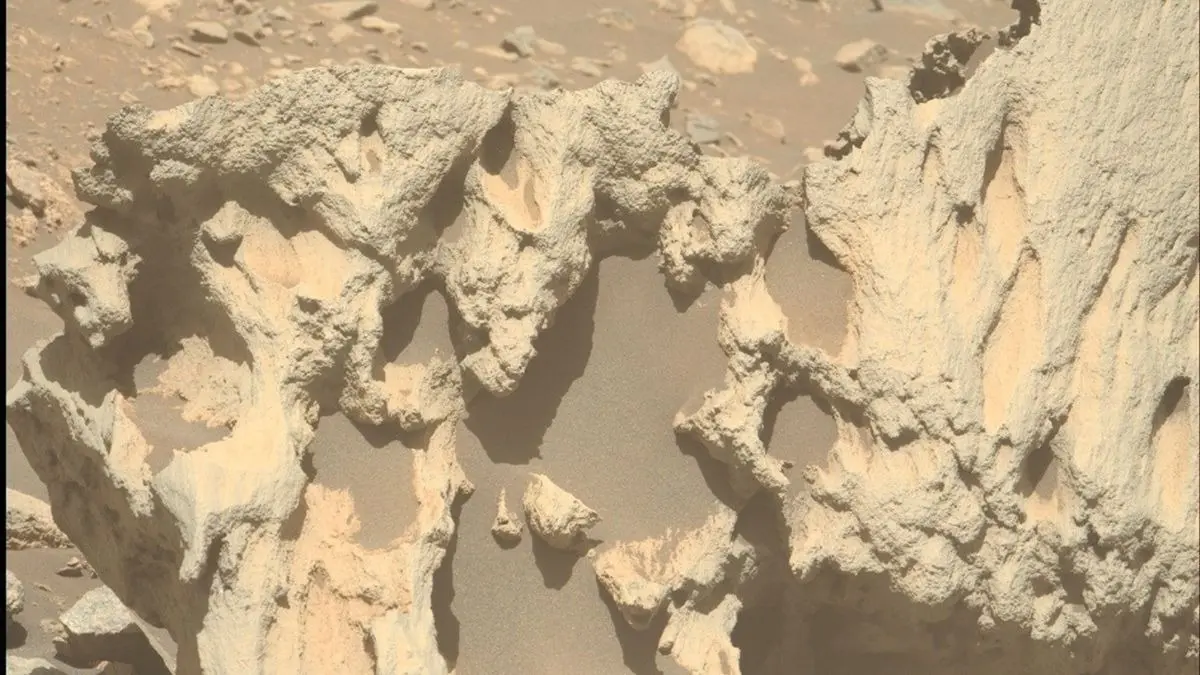
NASA’s Perseverance rover has likely spotted its first meteorite on Mars, more than four years after landing in Jezero Crater and nearly five years after launch, finally joining earlier rovers that routinely stumbled on space rocks. The boulder, nicknamed “Phippsaksla”, was found on September 2, 2025 (mission Sol 1612), standing out as a sculpted, metallic-looking rock amid flatter, fragmented terrain near the Vernodden region outside Jezero’s rim.
What Perseverance found
Researchers first noticed Phippsaksla in Mastcam-Z images, where it appeared as a high-standing, glossy boulder roughly 80–81 cm long, visibly different in colour and texture from the surrounding Martian rocks. Follow-up analysis with the rover’s SuperCam laser and spectrometers showed the rock is rich in iron and nickel, a composition strongly associated with metallic meteorites formed in the cores of large asteroids. If that origin is confirmed, this would be Perseverance’s first meteorite find since it touched down in Jezero on February 18, 2021.
Why this is a big deal
Previous rovers like Curiosity, Opportunity, and Spirit have all found iron–nickel meteorites on Mars, such as “Lebanon” and “Cacao” in Gale Crater and “Heat Shield Rock” in Meridiani Planum, so scientists had long expected Perseverance to see similar objects in Jezero. Until now, the lack of meteorite finds in the crater, despite its age and impact history, was something of a puzzle for the mission team. Phippsaksla’s discovery helps close that gap and supports expectations that Jezero’s floor, delta, and rim should also host meteorites delivered over billions of years.

How scientists will confirm it
The iron–nickel signal from SuperCam already makes a meteorite origin the leading explanation, but scientists will continue studying Phippsaksla with additional imaging and context measurements. They want to better understand its internal structure, weathering patterns, and how long it may have sat on the surface, as well as whether it could preserve clues about early solar system material. While Perseverance is not expected to cache this rock for return, its data can still be compared with meteorites found on Earth and by other Mars missions.
Advertisement
Meteorites and Perseverance’s main mission
Meteorite hunting is a side quest for Perseverance, whose primary job is to search for signs of ancient life in Jezero and collect rock cores for a possible sample return. Even so, metallic meteorites are scientifically valuable: they represent material forged deep inside differentiated asteroids and can reveal how such bodies formed, cooled, and were altered over time. On Mars, they also act as natural markers for surface processes, showing how wind, dust, and temperature swings slowly modify foreign material.
What comes next
Perseverance will keep exploring the Jezero rim and surrounding units, balancing its biosignature hunt with opportunistic targets like Phippsaksla when they appear. For planetary scientists, this first suspected meteorite in nearly five years of operations is both a long-awaited confirmation and a fresh data point for understanding how Mars accumulates and preserves visitors from deep space.
Advertisement
Published By : Shubham Verma
Published On: 26 November 2025 at 12:52 IST